Day 1: Chipping Campden to Stanton, 10 miles

The 2-hour train ride from Paddington station to Moreton in Marsh was uneventful.

IMG_1916

When I arrived in Moreton on Marsh, I was immediately approached by an unlicensed taxi driver who was looking to take someone to Chipping Campden.  I politely declined after he quoted me a price of 20 pounds.  Chipping Campden was only 6 miles away and my train fare was a mere 15 pounds.  I set off looking for the bus spot and when I finally found it, I discovered there is no bus service on Sundays.  Luckily, I had a pub guide, which directed me to a close establishment, where I enjoyed my first (and second) real ale of the trip.

IMG_1918

The publican gave me a number for a local cab and soon I was off, twisting and turning through the countryside on my way to Chipping Campden.  The driver, a Cotswolds native, was very enthusiastic about my trip and told me a couple cool stories.  Total cab cost 8 pounds.  Score.

My Chipping Campden inn was part 17th century pub, part Indian restaurant and part b&b.  I had a quick pint, checked in and headed to a more upscale pub for lunch.  After a bite and a beer, I roamed the village for a couple hours.  Every twist and turn in the road revealed new wonders.  This place is brimming with character and history.

IMG_6053

After my little walk, I crashed for a few hours, woke up, and had dinner and promptly went back to sleep.  I think my family in London showed me too good of a time the previous night.  I was beat.

I can’t begin to describe how excited I was to get on the trail this morning.  It’s hard to believe something I looked forward to for so long was finally starting.  I practically pranced to the stone that marks the beginning of the trail.

IMG_1943

In about 10 minutes, I found myself outside the village, climbing a steep hill.  At the top, I was treated with my first, of many, sheep pastures.  The next segment of the path was relatively flat, crossing through wheat fields and pastures.

IMG_1954

Overlooking Chipping Campden

IMG_1959

About three miles into the trail, I came upon Broadway Tower and climbed to the top.  On a clear day, you can see 12 counties.

IMG_1973

IMG_1976

It’s another two miles to the village of Broadway, almost all down hill.

IMG_1985

Broadway was another beautiful village.  I stopped in a pub for lunch and had a few beers.  On my way to Stanton, I made a wrong turn and walked about a mile before I realized I was no longer on the right trail.  Unfortunately, that mile was all downhill so I had to go back up a steep hill to get back on the path.  Normally, this kind of detour would make me all grumpy but today, I didn’t mind being on the trail for a little longer.

IMG_1997

A picture of a person minutes before they realized they are lost

Describing the path thus far is a little hard.  Today I went through open country with huge vistas, down to flat farmland, through numerous woods and down old country roads.  Every part was unlike the previous parts.  It was exactly what I was hoping for.

IMG_1996

I’m currently lying on the bed in my Stanton inn.  I don’t think I’ve heard a car for an hour, but I’ve heard at least four horses trot by.  Birds are chirping and the breeze is rustling the trees.  It’s bliss.  I’m off to explore Stanton now.  Here’s a short video of what it looks like right when you enter the village.

Arrival

I arrived at Chiping Campden, the official start of the Cotswold Way, yesterday. This place is beautiful. Utterly breath taking.


I’d like to describe it in detail but Wifi and cell signal is sparse, so I’m pecking this out  on my phone (which I managed to shatter yesterday) over breakfast.


Before jet lag caught up with me last night, I managed to visit three pubs and sat down to a nice Indian dinner.


I am minutes from starting the hike.  Flask is full, cigars at the ready. Belly butterflies bounce before boldly bounding Bathward.

Preface: On Real Ale

We all have our pet passions. Those things of which we spend a silly amount of time devoting our attention. That one thing that you know better than any of your friends simply because no one gets as excited about the subject as you do. I’m not talking about umbrella hobbies like video games or baking. I’m talking about that passion you have for Super Mario 3 or baking pies. You bore your friends with minutia about the subject and people begin to refer to you as the “Super Mario 3/Pie Guy/Gal.” If we, meaning you and I, spend any meaningful amount of time talking, without a doubt, I will subject you to a homily on the virtues of my pet passion: real ale.

WT282664_942long

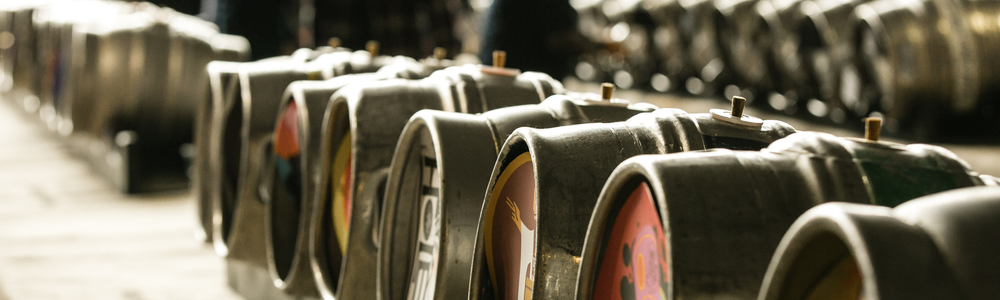
To be technical, “real ale,” also referred to as “cask ale” or “cask beer,” is beer that undergoes a maturing secondary fermentation in the vessel from which it is served. More simply, real ale is beer that is carbonated naturally by means of sugar and yeast, rather than by the application of pressurized CO2, and then served from the vessel, the “cask,” in which it was naturally carbonated. The result of this technique is a living product swimming with yeast; it is “real.” Typically, real ale contains less alcohol (2.5%-4.5%) than other craft beers. Almost all modern beer sold in the US, craft beer included, is carbonated in relatively giant tanks then moved into kegs, bottles or cans (clap your hands) for consumption. Historically, all carbonated beer would have been carbonated using the natural cask method.

The beer is served somewhere near 55 degrees Fahrenheit, the natural temperature of most English cellars. As a result, the beer contains about half the amount of dissolved CO2 as beer served using the modern method causing the uninitiated to complain that real ale is “warm and flat.” Of course, real ale is far from warm, it is just not as cold as the flavor muting, near freezing temperature employed by modern bars. And it is not flat, it’s just not fizzy.

Another unique feature of real ale is that the flavor changes rapidly over the life of the cask. Real ale is typically served employing a hand pump or a gravity tap. To facilitate the free flow of beer, a small venting hole is opened in the top of the cask. As beer leaves the tap, oxygen enters the cask and oxidizes the beer. If the beer is not consumed within a few days (usually about three) from the introduction of oxygen, it will spoil due to excessive oxidation.

cdbanner_9

Less cool temperatures, lower carbonation, low alcohol, yeast and evolving oxidation produces a full flavored beer with rounded edges. A wholesome fresh product more akin to warm bread right of the oven than soda. Beer so quaffable, it’s like drinking sun tea right off the porch.

Over the last few decades, in the face of an ever increasing homogenized beer market, a grassroots movement to restore real ale emerged in the UK. This movement, the “Campaign for Real Ale,” or “CAMRA” for short, effectively brought back real ale to the British pub and fostered a now thriving real ale culture. While real ale is generally lauded by American craft brewers, the production of it rarely extends beyond novelty; it is rarely available and when it is, it is often brewed out of style or chock full of exotic ingredients in an attempt to make it more appealing to the consumer. The resulting beer often lacks the one quality that makes real ale so great: drinkability.

sz-260x300-smores_cask

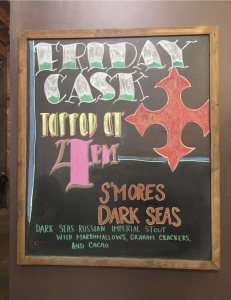
Example: Russian Imperial Stout (9.8%) on cask with marshmallows, graham crackers and cacao. Not my cup of sun tea.

The first time I drank an English pale ale “on cask,” I suddenly understood the pale ale style and what modern brewers are striving to imitate. I understood how beer was viewed as sustenance historically. And, oh yeah, it was delicious too. I’m a huge fan of real ale. Annoyingly huge.

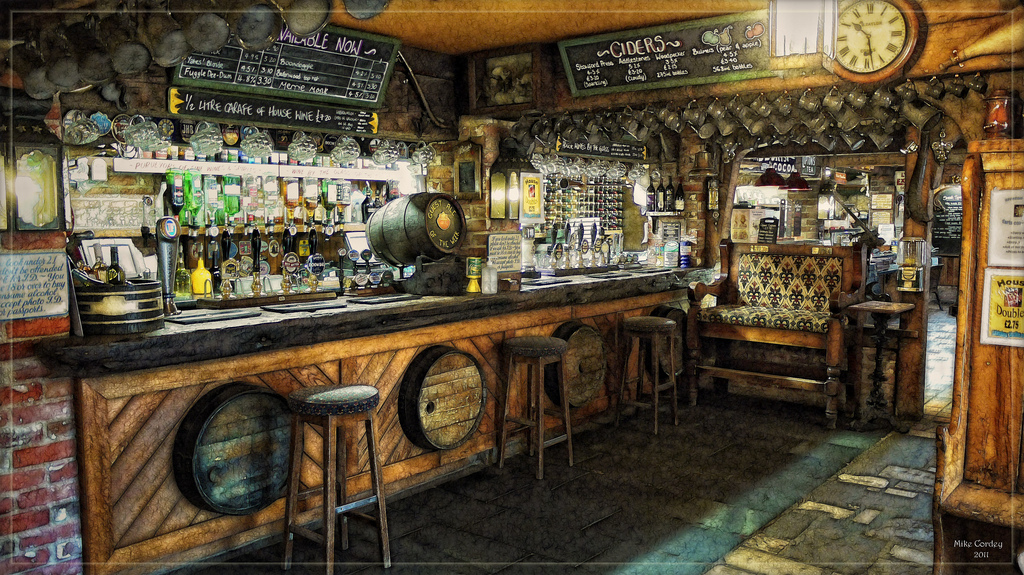
The Cotswolds is rich with old traditional pubs that serve up heaps of traditional cask – serving the type of beer I want to drink, in the exact atmosphere I want to drink it. There’s a type of nostalgic alchemy that occurs in an old slouching pub, with no TVs, real ale in hand and seated before traditional country fare. I’m transported to a time with fewer distractions and more connections to the physical environment around me. The irony that I feel the need to chase the past to live in the present is not lost on me, but that is exactly what I am striving for. Live in the moment, not the cloud.

5401359661_d7fdc1f664_b

There will be many pictures of pints and pubs here. I hope that, in light of this post, you will understand what role drinking plays on this adventure. It’s not only a way to pass time or socialize or relax. Drinking real ale and visiting traditional pubs is every bit a part of my pilgrimage as spending time alone in the country. A pedestrian’s passionate pursuit of perfectly pulled pints perpetuating peaceful personhood.

Of Fantasy and Fantasy Writers

In my late teens, I read the Space Trilogy by C.S. Lewis.  It begins:

THE LAST drops of the thundershower had hardly ceased falling when the Pedestrian stuffed his map into his pocket, settled his pack more comfortably on his tired shoulders, and stepped out from the shelter of a large chestnut tree into the middle of the road. A violent yellow sunset was pouring through a rift in the clouds to westward, but straight ahead over the hills the sky was the colour of dark slate. Every tree and blade of grass was dripping, and the road shone like a river.

This little nugget was my first introduction to the concept of a British countryside walking tour.

Here’s how these walking tours work: there are many publicly protected “footpaths,” often hundreds of years old, that honeycomb the British countryside.  Anyone sticking to these footpaths is free to stroll through otherwise privately owned lands.  Many of these footpaths are dotted with cozy inns strategically placed a day’s walk from each other, which grants the walker assurance of a warm meal and a place to stay at the end of a long day.  Often such tours span numerous days.

Something about this inn-hopping, English countryside hike resonated with me.  Get up in the dewy morning.  Eat a hearty breakfast and hit the rolling countryside.  Forests, ruins and ancient drystone walls.  Pastures, sunsets and kissing gates.  Did my ancestors ever trod paths like this?  Did they travel lightheartedly across the countryside to some forgotten purpose? hp_cw Over the decades, the desire to take one of these hikes became so strong that I began to consider it as a kind of aimless pilgrimage.  Sustenance for my metaphysical me.  There’s a sense of connecting with the real past.  Touching the things my ancestors touched and experiencing the raw beauty of nature in the same way they must have.  I want to sit in a slouching 17th-century pub, ceilings too low for my stature, and drink a pint a traditional beer and listen to a folk song and forget about the last 200 years.  I want to get lost in history.

To that end, I’ve booked my fantasy holiday to southwest England to walk the Cotswolds Way.  The Cotswolds Way is 102-mile footpath that starts in the medieval market town of Chipping Campden, weaves through a couple dozen or so quintessential English villages and ends in the Georgian city of Bath.  Nine days and eight nights. Each morning, I will start out at a country inn and walk anywhere from 10 to 17 miles to another country inn.  Along the path are numerous sites of interest, including neolithic settlements, medieval ruins and English civil war battlefields.  And there will also be an abundance of pubs. cotswoldmap I’m going alone, because as Lewis wrote:

Walking and talking are two very great pleasures, but it is a mistake to combine them. Our own noise blots out the sounds and silences of the outdoor world; and talking leads almost inevitably to… [a] farewell to nature as far as one of our senses is concerned.

One wayfarer wandering without words.  I intend to chronicle my adventure here.  If your August is slow, come along for the stroll.